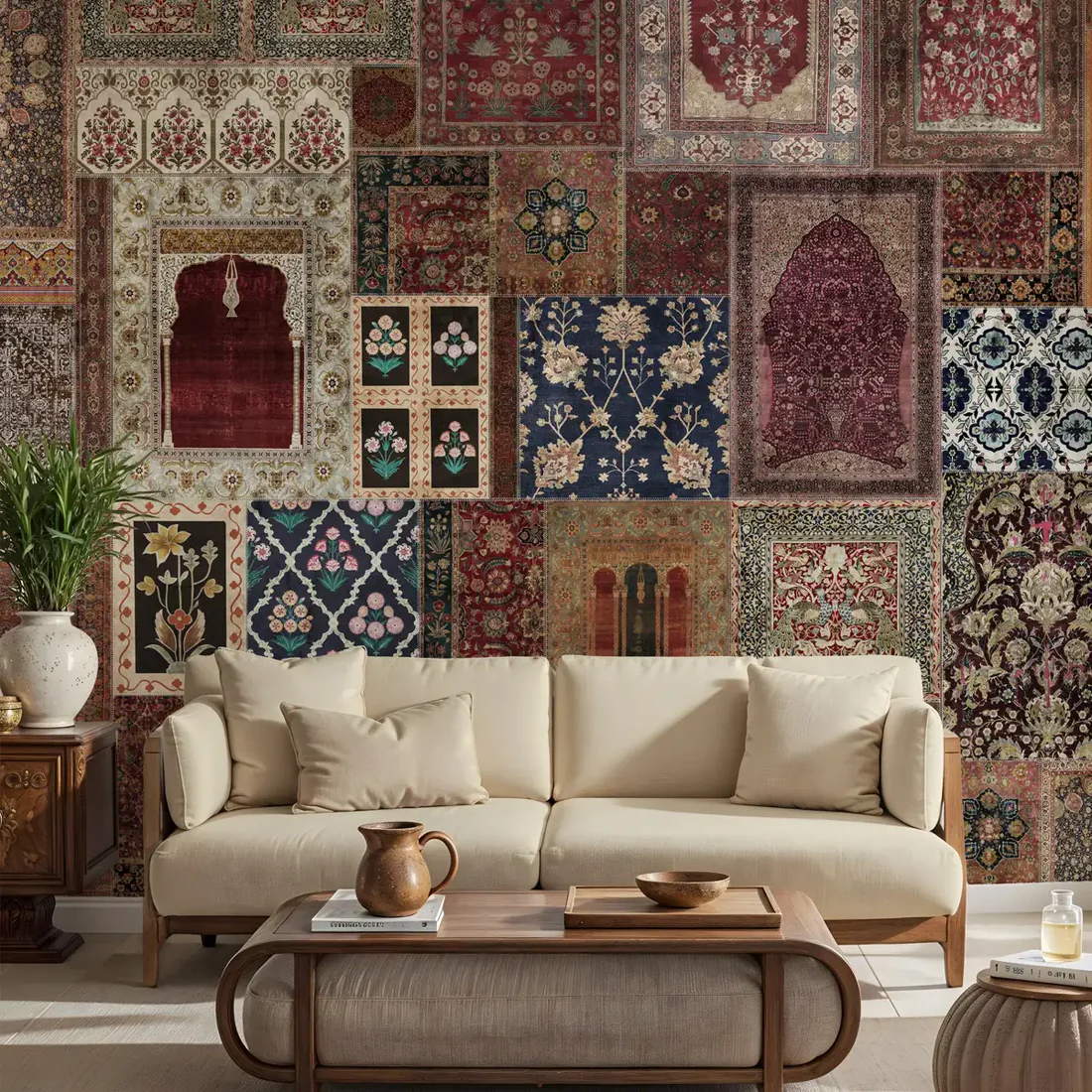
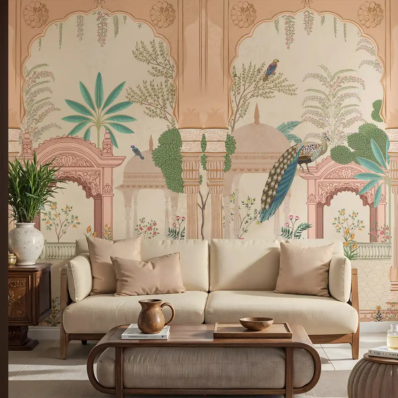
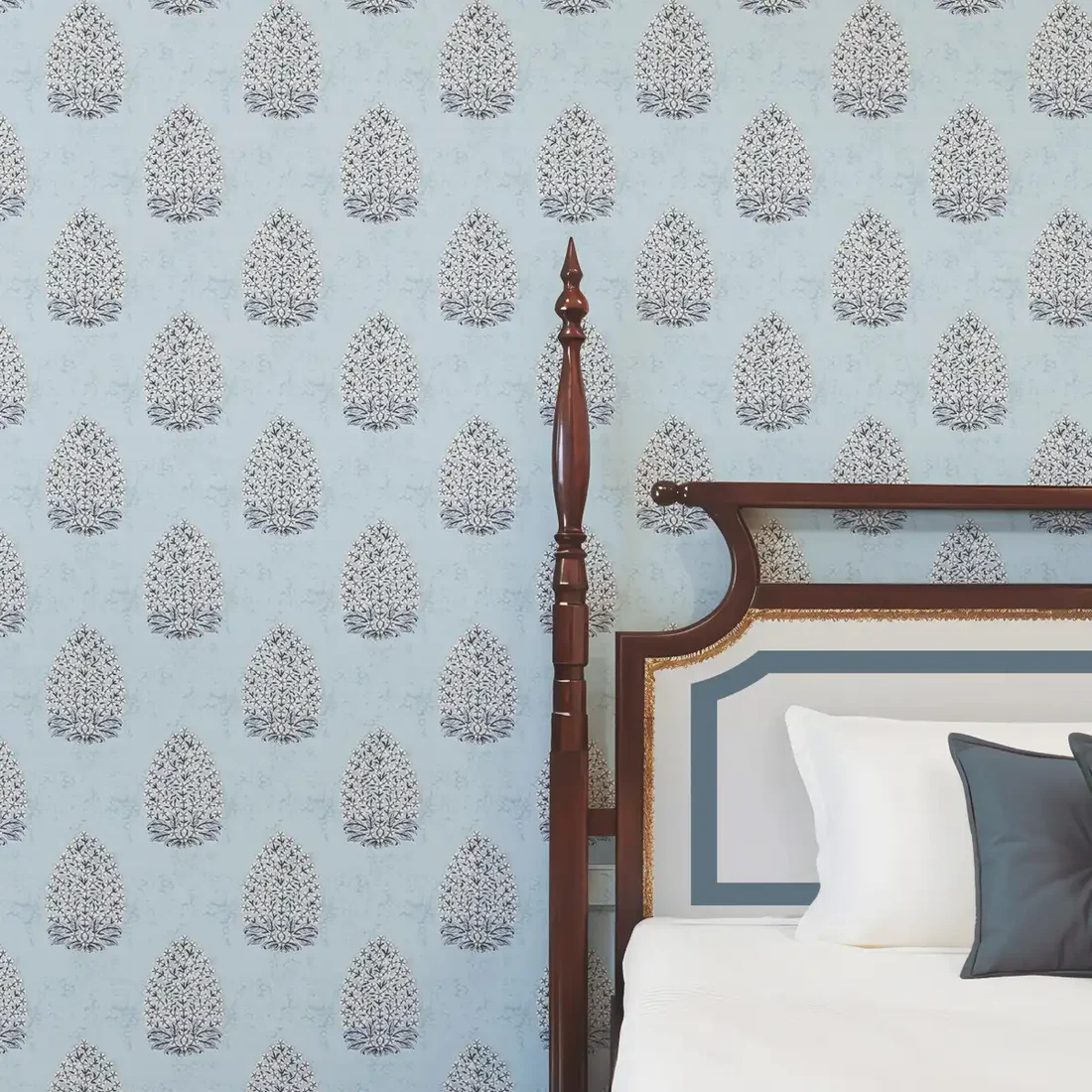
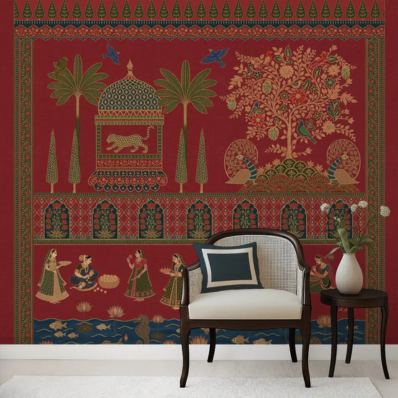
India does not have one decorative tradition, it has dozens, and most of them predate wallpaper by several centuries. The designs in this collection are named after the traditions they draw on. This page explains what those traditions actually are, so you know what is going on your wall.
Pichwai: the cloth that hangs behind the shrine
The word pichwai means “that which hangs at the back”. These were painted textile backdrops made to hang behind the idol of Shrinathji in the temple at Nathdwara, Rajasthan, a tradition roughly four centuries old that grew up around the Pushti Marg sect after the idol was moved from Govardhan during the Mughal period.
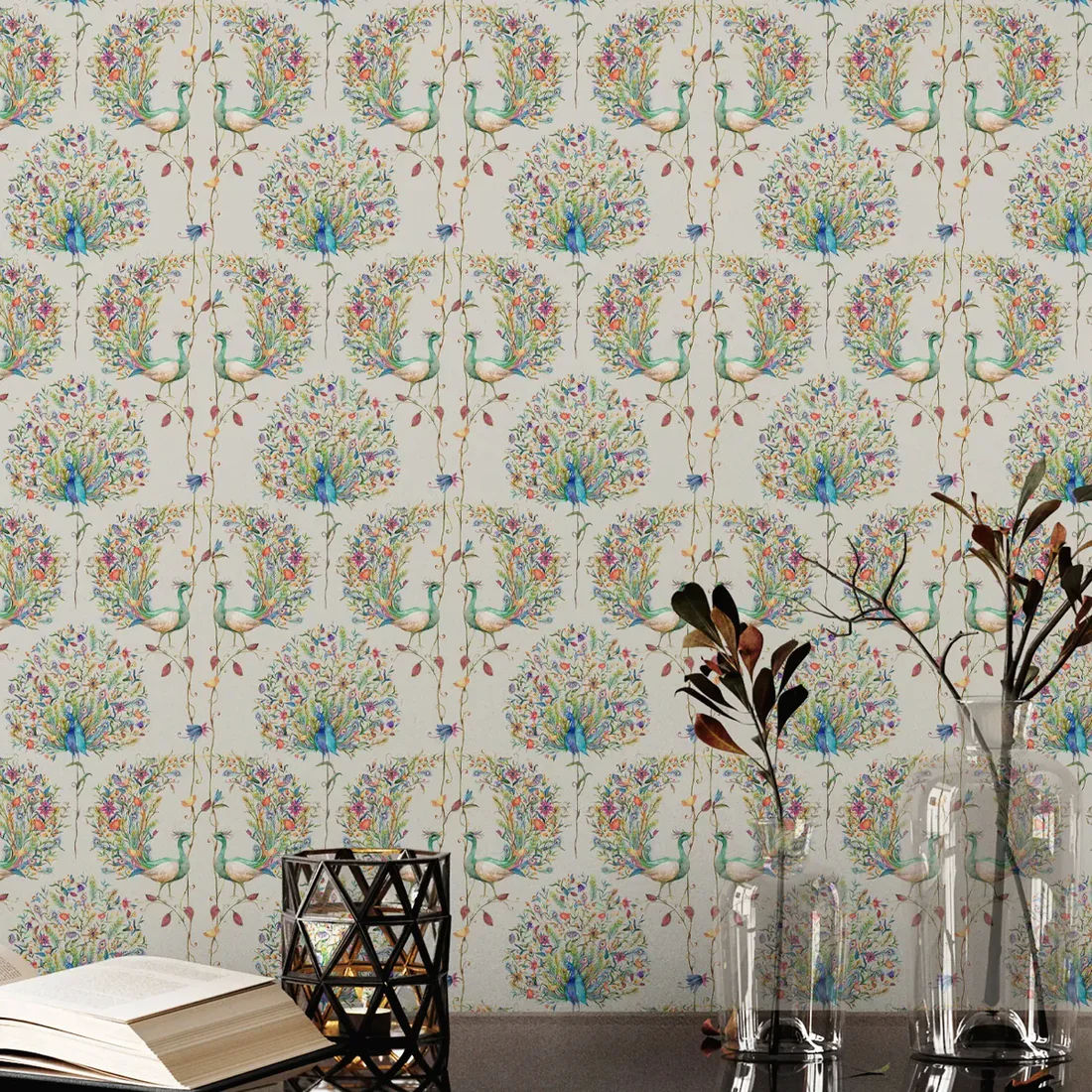
Painters worked on handspun cotton stiffened with starch, using pigments ground from minerals, stones, vegetable dyes, and often gold and silver. The motifs carry meaning rather than filling space: the lotus for purity, the kadamba tree for Krishna’s Vrindavan, cows for abundance, elephants for prosperity, and peacocks for love and the monsoon. If you have wondered why so many Pichwai designs are crowded with cows and lotuses, that is why.
Madhubani: painted by women, on the walls of houses
Madhubani, also called Mithila painting, comes from the Mithila region of Bihar and holds a Geographical Indication tag. It was traditionally painted by women on the freshly plastered mud walls and floors of their own homes, which makes it one of the few great Indian art forms that began as wall decoration rather than moving onto walls later.
Artists used fingers, twigs, nib-pens and matchsticks, with colour made from what was to hand: vermilion and mustard seed for red, turmeric for yellow, indigo for blue, cow dung and lampblack for a greenish black. The defining rule is that no space is left empty. Gaps get filled with flowers, birds, animals and geometry, which is why a Madhubani wall reads as dense rather than sparse. It only moved onto paper and canvas in the 1960s, as a way of bringing income into the region.
Kalamkari: twenty-three steps and a pen made from a stick
The name is Persian, kalam for pen and kari for craftsmanship, coined under the Golconda sultanate. Telugu artisans called it vraata pani, writing-work. There are two recognised styles and they are genuinely different crafts: Srikalahasti is hand-drawn with the pen and leans toward temple imagery and scenes from the epics, while Machilipatnam is block-printed, shows clear Persian influence under Mughal patronage, and favours interlacing leaves, cartwheels and lotus forms.
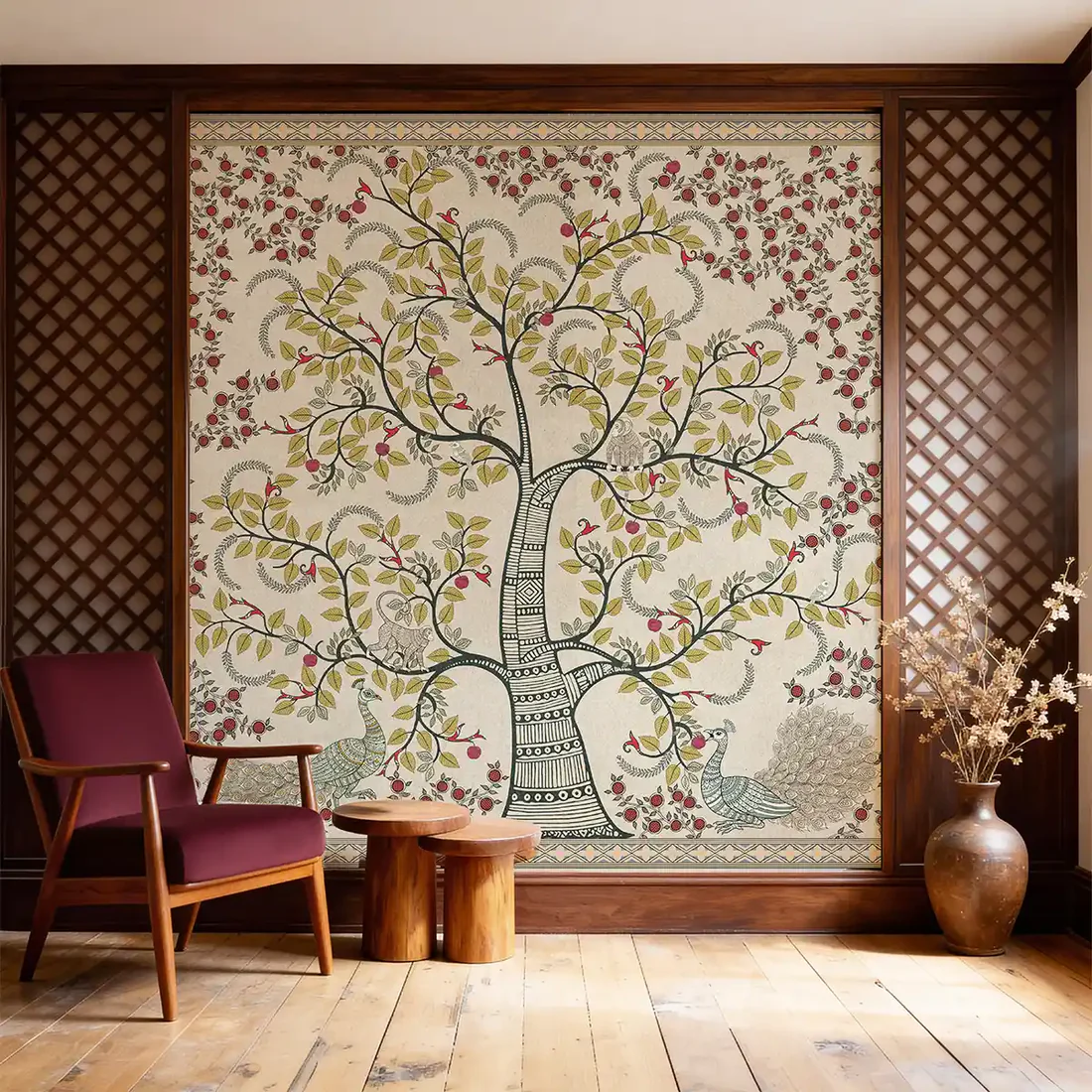
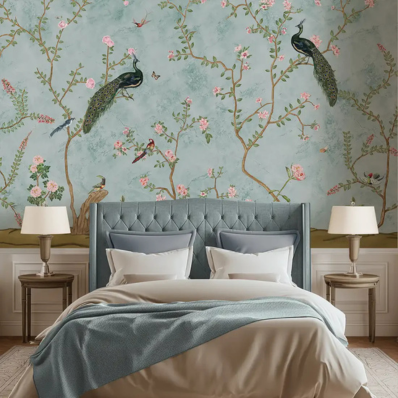
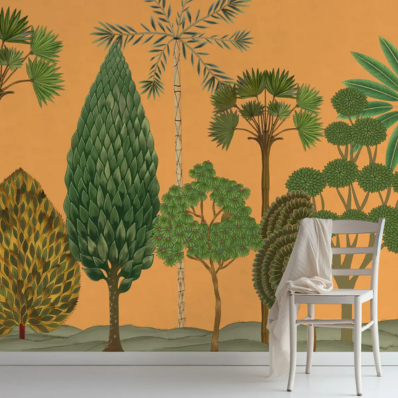
The traditional process runs to twenty-three steps and uses natural dyes only, drawn from roots, leaves, alum and iron. The pen itself is a bamboo or date palm stick with a bundle of fine hair at the tip, soaked in jaggery water before it touches the cloth. The Tree of Life, one of the best-known subjects in the Machilipatnam style, is the pattern most people recognise without knowing its name.
Choosing an Indian motif for a Dubai home
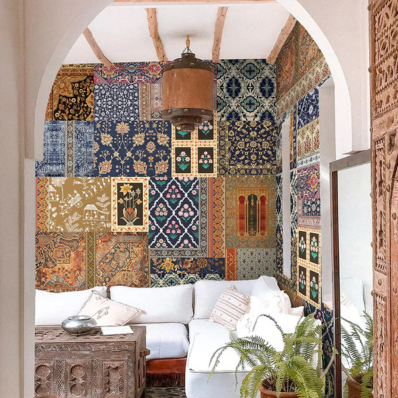
Pichwai and Madhubani designs are busy by nature and hold their own against strong light, which suits a wall that takes direct sun for part of the day. Because both traditions fill the whole surface, they work better as a single feature wall than wrapped around a room, where the density can become tiring. Kalamkari, particularly the Tree of Life layouts, is more open and tolerates being used across more than one wall.
Large motif designs also need accurate measuring. A Tree of Life or a full Pichwai composition has a specific centre, and where that centre lands relative to your furniture matters more than it does with a repeating pattern. That is decided on the site visit, not in the shop.
Fitting, warranty and made-to-measure
Every design in this collection can be printed to the dimensions of your wall rather than sold by the roll. Installation is included at no charge and covered, along with the wallpaper, by a 3-year warranty. A free measurement visit sets the drop and the position of the motif before anything goes to print.
Mwalls is a licensed Dubai contractor, licence 906031, based in Al Quoz, rated 4.9 from 57 Google reviews across more than 500 completed projects.
Book a free measurement visit or call +971 52 469 3093 to see samples.